
Look, I get the skepticism. "AI" has become the most overused word in business software since "synergy." Half the companies slapping AI on their marketing page are just running a basic if/else script behind a chatbot.
But here's the thing — the numbers are getting hard to ignore. And I don't mean some consultant's projection. I mean actual, measurable results from service companies that deploy AI correctly.
The field service management software market is projected to grow from $5.64 billion in 2025 to $9.7 billion by 2030. The companies driving that growth aren't chasing trends. They're cutting costs and recovering revenue they didn't know they were losing.
The Real ROI Numbers
These aren't theoretical numbers. According to 2025-2026 industry research (McKinsey, PwC, Deloitte), companies leveraging AI automation report these returns across knowledge-intensive, workflow-heavy processes - which describes every service business on the planet.
The key insight: 87-88% of organizations report AI has positively impacted their annual revenue growth - not just cost savings, but actual top-line revenue increases through better lead conversion, faster sales cycles, and improved customer retention.
Where Service Businesses See Highest Returns
The highest ROI comes from workflows that combine high volume with high complexity:
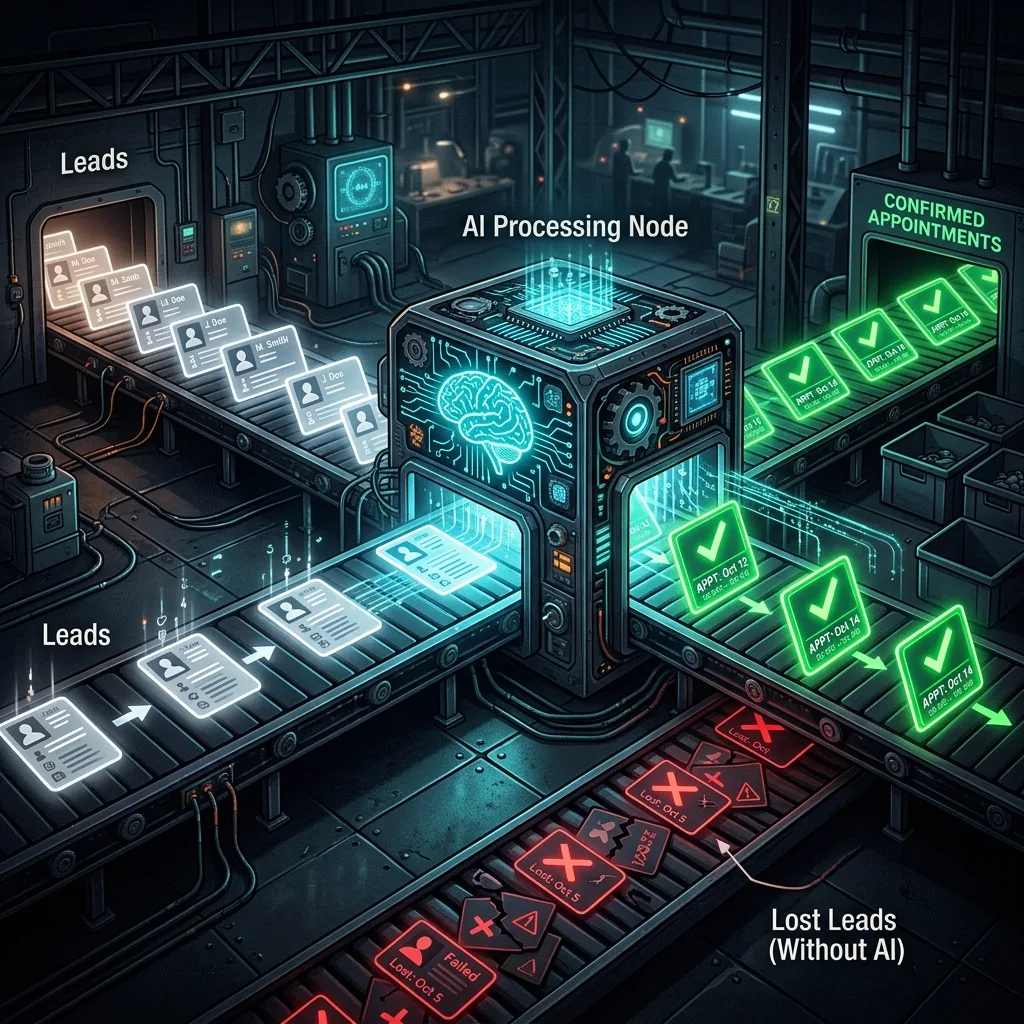
1. Lead Follow-Up Automation - The fastest payback. Most service businesses lose 40-60% of inbound leads because nobody follows up fast enough. AI that auto-calls, sends texts, and creates follow-up tasks within 60 seconds of a form submission directly recovers revenue you're already losing.
2. AI Call Transcription & Action Extraction - Your reps make 50-100 calls per day. Without AI, the notes from those calls are incomplete, inconsistent, or nonexistent. AI transcription with automatic action item extraction means every call produces structured data - customer needs, appointment requests, quotes promised - without your rep typing a single word.
3. Intelligent Dispatch & Routing - The difference between a 3-job day and a 5-job day per technician. AI-optimized routing considers traffic, technician skills, parts inventory, and customer priority to maximize throughput.
AI-Powered Dispatch & Scheduling
For field service operations, dispatch is where AI creates the most dramatic efficiency gains:
| Metric | Manual Dispatch | AI-Powered Dispatch |
|---|---|---|
| Average Response Time | 45-90 minutes | 15-30 minutes |
| Jobs Per Technician/Day | 3-4 | 5-7 |
| Drive Time (% of day) | 35-45% | 20-28% |
| First-Time Fix Rate | 65-72% | 85-92% |
| Scheduling Errors | 12-18% | 2-4% |
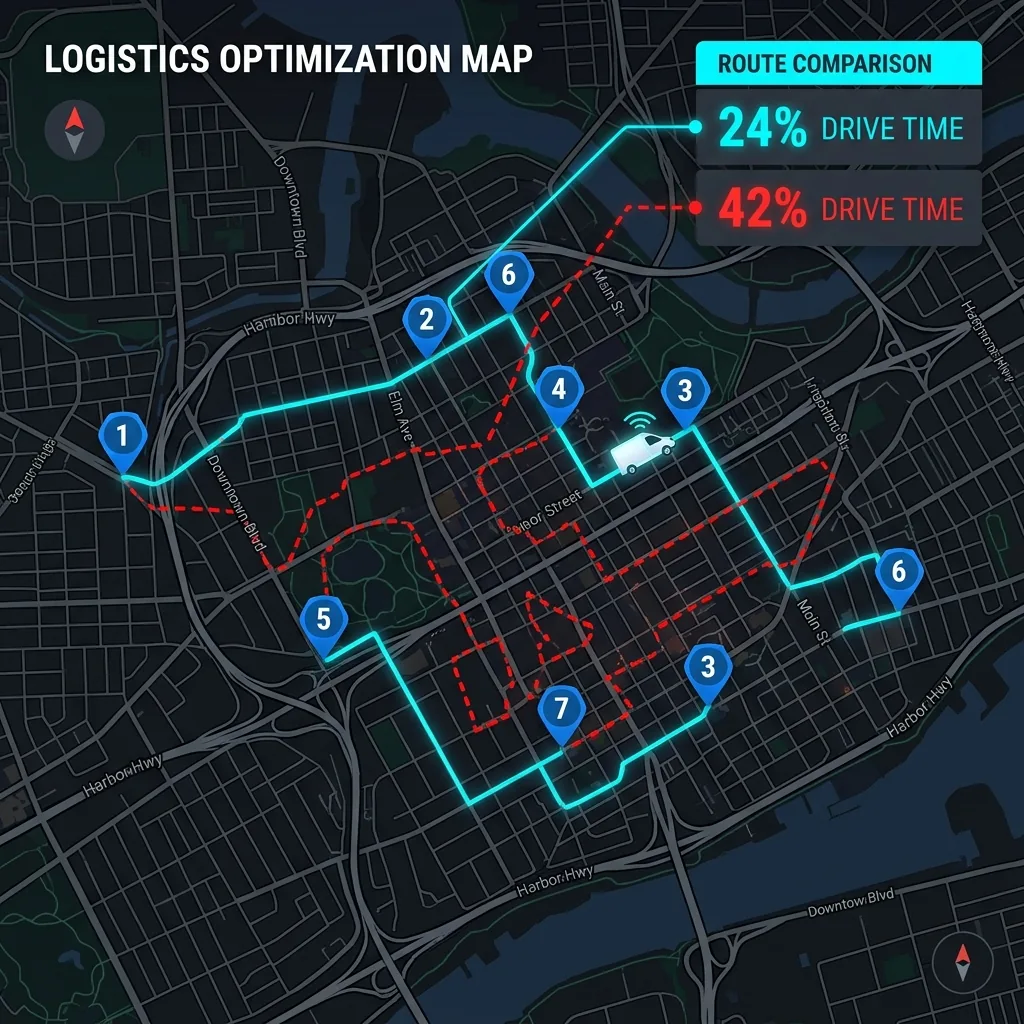
The compounding effect is enormous: more jobs per day + less drive time + fewer return visits = 30-50% more revenue per technician without hiring a single additional person.
AI in Sales Operations
Service business sales teams waste an estimated 66% of their time on non-selling activities: updating CRM records, writing follow-up emails, scheduling callbacks, and searching for customer history.
AI automation in sales operations delivers:
- Automated CRM data entry - No more manual logging. AI captures every interaction automatically.
- Lead enrichment - AI scores and prioritizes leads based on behavioral signals, call sentiment, and historical conversion data.
- Follow-up sequences - AI creates and sends personalized follow-ups across email, SMS, and phone - triggered by specific events (missed call, quote sent, invoice overdue).
The result: your 5-person sales team operates with the precision and throughput of a 50-person floor - because AI handles everything that isn't a live conversation.
AI for Customer Service
AI-powered customer service agents now resolve 80% of routine inquiries without human intervention. For service businesses, this means:
- After-hours coverage - AI handles scheduling questions, appointment confirmations, and basic troubleshooting 24/7.
- 60% faster response times - No hold queues, no voicemail black holes.
- 85-90% fewer data entry errors - AI captures customer information with higher accuracy than manual processes.
The most effective approach isn't "replace your people with AI" - it's "let AI handle the repetitive tier-1 work so your people can focus on high-value interactions that actually build relationships."
How to Measure AI ROI Correctly
A common mistake service businesses make: buying AI tools without defining what they're measuring. Here are the KPIs that actually matter:
Revenue per employee - Are you generating more revenue per person?
Lead-to-close conversion rate - Is AI helping you close more deals?
Average time-to-first-response - Are leads getting contacted faster?
Jobs completed per technician per day - Is dispatch optimization working?
Customer lifetime value (CLV) - Is AI improving retention and upsell rates?
Getting Started Without Overspending
You don't need a $10,000/month AI platform. The best approach for service businesses:
- Start with one workflow - Pick your biggest bottleneck (usually lead follow-up) and automate it first.
- Use a platform with built-in AI - Don't cobble together 6 different AI tools. Use a platform like Chillead that has AI transcription, smart scheduling, and automation built into every plan.
- Measure before and after - Baseline your current metrics, implement AI, measure again at 30/60/90 days.
- Scale what works - Once you see ROI in one area, expand to dispatch optimization, then customer service, then sales intelligence.
The field service industry is at an inflection point. Businesses that adopt AI-powered operations now are positioning themselves to operate at a level their competitors literally cannot match - not because they hired more people, but because their existing team became 3-5x more effective.